Last updated: September 29, 2026
Quick Answer
Most local service businesses should aim to publish one high-quality blog post per week. If that’s not realistic with your schedule, two posts per month is the minimum cadence that still builds momentum for local SEO. What matters more than the exact number is picking a schedule you can actually keep for a full year, because consistent Local Business Blog Posts beat sporadic bursts every time.
Key Takeaways
- One post per week is the sweet spot for most local service businesses balancing quality and consistency.
- Two posts per month is the realistic floor. Below that, blogging stops moving the needle for local SEO.
- Businesses publishing 11 or more posts per month can see roughly 3x more traffic than those posting once a month, based on long-running HubSpot benchmarking cited by Clever Marketing.
- Quality beats quantity. A rushed post published to hit a quota can hurt your credibility more than skipping a week.
- New blogs (under six months old) can post more often to build momentum; established blogs can shift to fewer, deeper posts.
- Blogging works best alongside a complete local SEO setup, not as a replacement for it.
- Google Business Profile updates and blog posts should work together, not compete for your time.
- Social media alone won’t replace a blog for local search visibility. The two do different jobs.
- Most local businesses see early traction in three to six months, with compounding results after a year.
- The biggest mistake I see is picking an unsustainable schedule, publishing thin content, then quitting after a month.
How Often Should Small Businesses Post Local Business Blog Posts?
For a small, local service business, one post a week is a realistic target that fits how most content marketers already operate. Recent reporting shows the average content marketer now publishes about 57 posts a year, which works out to a little over one a week, meaning weekly blogging has become the norm rather than an aggressive stretch goal, according to Carly’s content marketing statistics roundup.
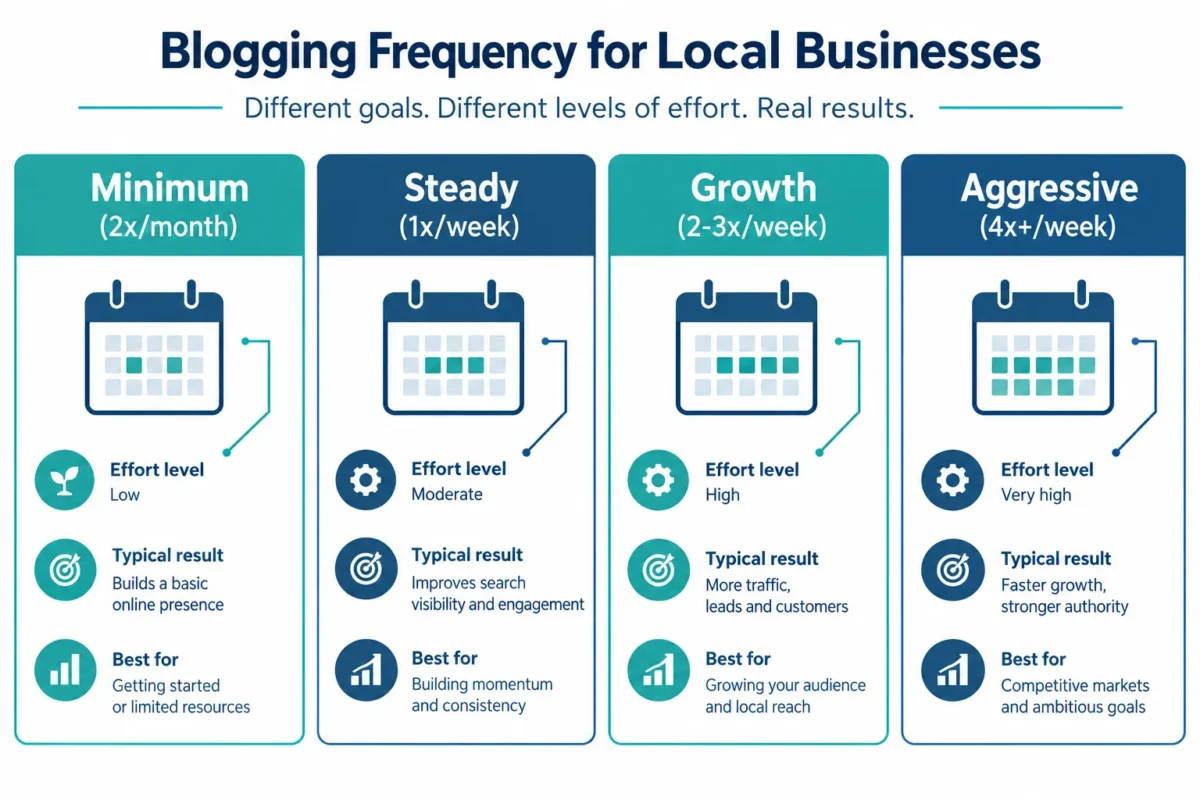
If posting weekly feels like too much on top of running your business, don’t panic. Two posts a month is the floor where a blog still earns its keep for local SEO. Fewer than that, and Google (and your customers) mostly forget your blog exists.
Choose weekly if: you have an hour or two free most weeks, or a staff member who can write.
Choose twice a month if: you’re a solo owner-operator juggling jobs, calls, and quotes with no marketing help.
A quick example: a Durham Region plumber I worked with started with one post every two weeks about seasonal plumbing issues. Six months in, those posts were quietly bringing in search traffic from people searching “frozen pipes Oshawa” during cold snaps.
What’s the Ideal Blogging Frequency for Local SEO?
The ideal frequency for local SEO is one to two posts per week for most small businesses, though the “right” number shifts with how old your blog is and how competitive your market is. A newer blog benefits from a slightly higher cadence early on, then can taper off once it has traction.
Contentful’s 2026 benchmarks describe a “sweet spot” of roughly 10 to 20 posts per quarter for most teams before the returns start to flatten out, which translates to about one to two posts a week, as summarized by Acta’s content consistency guide. That guide also makes a point I fully agree with: chasing a competitor’s publishing volume without the resources to sustain it usually hurts quality and return on investment more than it helps rankings.
Here’s a simple way to match cadence to your local SEO goals:
| Your Situation | Recommended Cadence | Why |
|---|---|---|
| Brand-new local online presence | 2-3 posts per week | Builds indexed pages fast, signals activity to Google |
| Established site, steady growth | 1 post per week | Sustainable, keeps content fresh without burnout |
| Solo owner, limited time | 2 posts per month | Minimum floor to keep local SEO benefits alive |
| Highly competitive market (legal, dental) | 1-3 posts per week | Matches competitor content volume without overextending |
How Many Blog Posts per Week Should a Local Business Publish?
Most local businesses do best with one to two posts per week, and I rarely recommend more than that for a solo owner or small team. A February 2026 content-strategy analysis found industry norms vary: tech and SaaS companies often post two to four times weekly, lifestyle brands one to three times, and finance blogs one to two times, according to Salesgenie’s business blogging statistics.
For a local service business, like a roofer, dentist, or law firm in the Durham Region, one to two posts weekly is plenty. You’re not competing with national media outlets. You’re trying to answer the exact questions your neighbours are typing into Google before they call someone.
Common mistake: trying to match a big-city competitor’s five-post-a-week schedule with no writer, no system, and no time. That plan dies in month two.
Does Posting More Local Business Blog Posts Help Rankings?
Posting more often can help rankings, but only up to a point, and only if quality holds steady. A 2026 synthesis of HubSpot data found companies publishing 16 or more posts a month saw roughly 3.5 times more traffic than lower-frequency publishers, with 11-plus posts a month still delivering about 3 times more traffic than businesses posting zero to one post monthly, per Clever Marketing’s business blogging guide.
That said, those numbers come from companies with dedicated content teams. For a local plumber, electrician, or small law office, hitting 16 posts a month isn’t realistic and honestly isn’t necessary. A steady weekly post, done well, still moves you up the local search results over time because Google rewards fresh, relevant, locally-focused content, not just volume.
“A sustainable two posts a week outperforms an unsustainable five posts a week.” That’s the honest math behind long-term blogging success.
What Happens If a Local Business Doesn’t Blog Regularly?
If you stop blogging or post erratically, your search visibility tends to stall, and any early gains slowly fade. Google favours sites that show ongoing activity and freshness, especially for local searches where competition is tight.

A business blogging statistics roundup notes that companies posting two to six times a week are about 50% more likely to see stronger engagement and better lead quality than infrequent bloggers, and suggests two to four posts weekly as a strong compromise if daily posting feels unrealistic, as reported by FitSmallBusiness.
Edge case: if you paused blogging for six months but your older posts still rank well, you may not lose rankings immediately. But you will stop gaining new keyword rankings, and competitors who kept publishing will pull ahead.
Can Posting Too Many Blog Posts Hurt My Local Business?
Yes, posting too often can hurt you if it means cutting corners on quality just to hit a number. Thin, repetitive, or poorly written posts can actually drag down how Google views your whole site, and they waste the trust of readers who came looking for real answers.
A February 2026 content-strategy analysis warned that high-frequency blogs can maximize traffic and backlinks, but risk higher bounce rates if the content lacks depth, while a more moderate, biweekly-to-monthly rhythm often balances traffic and engagement better for businesses focused on generating leads rather than raw traffic, according to Salesgenie.
Common mistakes I see local business owners make:
- Publishing five posts in one burst, then going silent for three months.
- Copying and slightly rewording the same “top tips” post over and over.
- Skipping the local angle entirely (no mention of your town, neighbourhood, or service area).
- Writing for search engines only, with no real answer for the customer reading it.
- Never checking which posts actually bring in calls or form submissions.
Best Blogging Schedule for Your Google Business Profile
Your blog and your Google Business Profile should work as a team, not two separate projects competing for the same hour of your week. A good rhythm is one blog post weekly, paired with a Google Business Profile update or post every week or two, linking back to your latest blog content when it’s relevant.
This matters because your Google Business Profile is often the first thing a local customer sees, and a blog post that answers a specific local question (like “how much does furnace repair cost in Whitby”) gives you something worth linking to instead of a generic “we’re open” update. I build this pairing into every affordable WordPress website I design for service business clients, so the blog actually feeds the local profile instead of sitting disconnected from it.
How to Create a Consistent Local Business Blog Posts Schedule
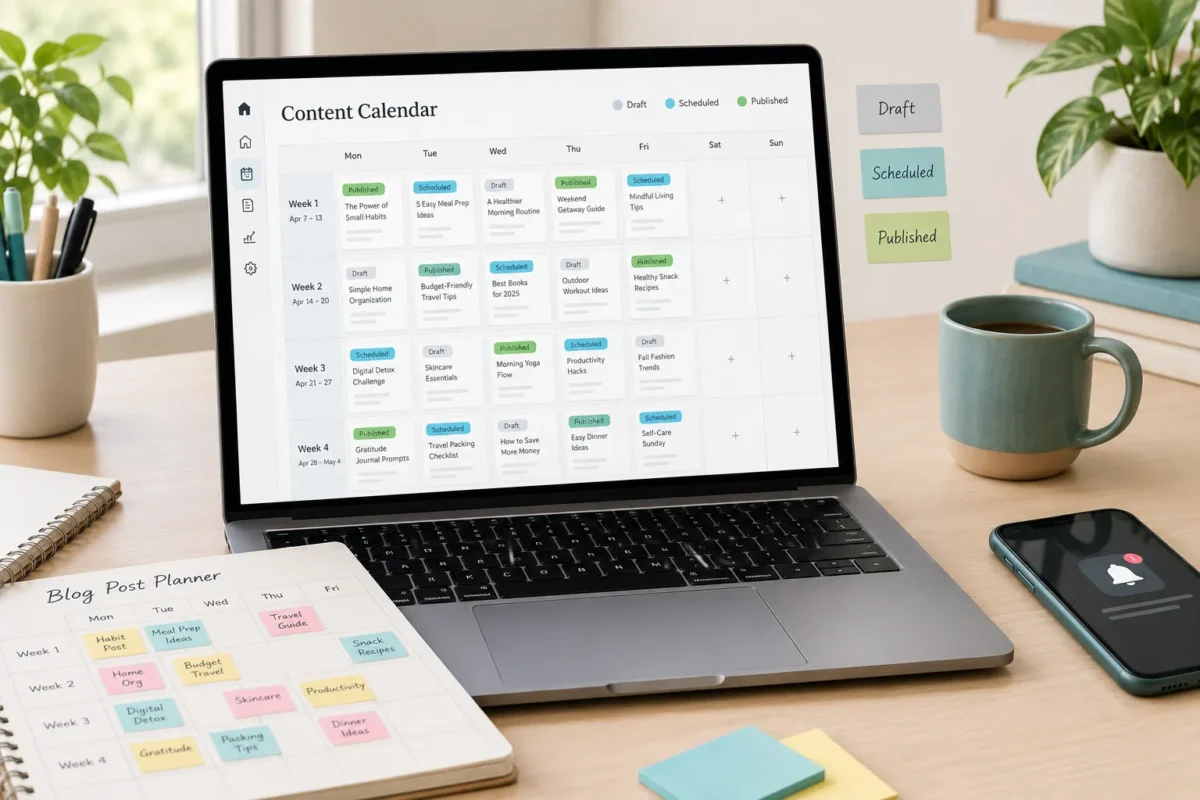
Building a consistent schedule starts with picking a realistic number, not an ambitious one, and writing it down somewhere you’ll actually see it. Consistency, tracked over months, beats intensity, tracked over days.
A March 2026 content-calendar guide reinforces this, noting that weekly or twice-weekly publishing accelerates traffic and engagement, while a fortnightly rhythm still works well for more targeted campaigns, and that a cadence maintainable for six months beats a short sprint followed by a long gap, per Incremys’ content calendar resource.
Five steps to a schedule you’ll actually keep:
- Pick your realistic frequency (weekly or twice monthly, not both extremes).
- Block a recurring 60- to 90-minute slot in your calendar, same day each week.
- Keep a running list of customer questions to turn into post topics.
- Draft, edit, publish, then promote each post on social media and your Google Business Profile.
- Review your top three posts every quarter and update or expand them.
Do Local Businesses Really Need to Blog, or Is Social Media Enough?
Social media and blogging do different jobs, so relying on social alone leaves a real gap in your local online presence. Social posts disappear from feeds within hours or days. A well-written blog post can keep bringing in search traffic for years.
Twilio’s 2026 content marketing best practices piece makes a similar point: effective teams may publish daily or twice weekly, but the real advantage comes from a maintained schedule and calendar, not sporadic bursts across whichever platform is trending, as outlined by Twilio.
Decision rule: use social media to drive quick engagement and remind past customers you exist. Use your blog to capture new customers actively searching Google for the service you offer. You need both, but only one of them builds long-term search rankings.
Should Every Local Business Have a Blog?
Not every business needs a blog, but most local service businesses benefit from one, especially those with higher-value jobs or longer decision times. Law firms, dental practices, contractors, and home service companies tend to see the strongest return, because customers research heavily before booking.
A February 2026 content-strategy resource notes that industries with more considered purchases, like finance and professional services, often do well with a steadier one to two posts weekly rather than a high-volume approach, according to Salesgenie’s blogging statistics.
Skip or scale down blogging if: you run a business with almost no online research phase, like an ice cream stand with mostly walk-in, impulse customers. Your time is better spent on visuals and local listings than long-form posts.
How Long Does It Take to See Results From Local Business Blogging?
Most local businesses start seeing early signs of traffic and inquiries within three to six months of consistent posting, with stronger, compounding results after a full year. Blogging is not a light switch. It’s closer to planting a garden that needs regular tending.
Individual posts often take weeks to get indexed and ranked, and your first handful of posts usually generate modest traffic while your site builds authority. Consistency over that first six to twelve months matters more than any single “viral” post.
Quick example: a home renovation client saw almost no blog traffic for the first four months. By month eight, three posts about specific renovation costs in their town were driving a steady trickle of form submissions every week, without any paid ads.
Tools to Help Schedule and Maintain Local Business Blog Posts
The right tools remove the guesswork from staying consistent, so you spend your limited time writing instead of remembering what’s due. You don’t need anything fancy or expensive.
Simple tools that actually work for local businesses:
- A shared Google Sheet or Calendar with post topics, due dates, and status.
- WordPress’s built-in scheduling feature to queue posts in advance.
- A running notes app list of customer questions to turn into future topics.
- Basic analytics (Google Analytics or Search Console) to track which posts actually convert locally into calls or form fills.
This is exactly the kind of no technical jargon setup I build into every WordPress Maintenance plan for my clients across the Durham Region. You shouldn’t need to be a developer to keep your blog running smoothly, and you shouldn’t have to think about it every single day.
Frequently Asked Questions
How often should a local business publish blog posts? Most local service businesses should aim for one post per week, with two posts per month as the realistic minimum to keep local SEO benefits active.
Is blogging still worth it for small businesses in 2026? Yes. Consistent, locally-focused blog posts continue to drive search traffic and support local SEO rankings, especially when paired with a strong Google Business Profile.
What happens if I only blog once every few months? Sporadic blogging rarely builds momentum. You’ll likely see minimal ranking improvement and may lose ground to competitors who post consistently.
Can I hire someone to write my blog posts? Yes, many local businesses outsource writing to freelancers or agencies while keeping topic ideas and local knowledge in-house for accuracy.
Do blog posts help with Google Business Profile rankings? Blog posts don’t directly rank your Google Business Profile, but linking fresh, relevant content from your profile can support overall local visibility.
What’s the biggest mistake local businesses make with blogging? Picking an unsustainable schedule, publishing rushed content to keep up, then quitting entirely within a few months.
Should a law firm or dental practice blog more often than a restaurant? Generally yes. Businesses with longer research phases, like legal or dental services, tend to benefit more from steady, informative posts than quick-decision businesses like restaurants.
How long is a good local business blog post? There’s no strict rule, but posts answering a real local question in genuine detail, often 600 to 1,200 words, tend to perform well without feeling padded.
Conclusion
Here’s what I would suggest: post once a week if you can manage it, or two posts a month if that’s your realistic ceiling, and then stick with it for at least six months before judging results. Local Business Blog Posts don’t need to be perfect or lengthy. They need to answer real questions from real people in your community, published on a schedule you can actually maintain.
I’ve watched too many local business owners burn out chasing five posts a week, then give up entirely. A steady, realistic rhythm beats a burst-and-quit pattern every time. If you’re not sure where to start, or you’d rather have someone handle the technical side while you focus on running your business, that’s exactly what I help with through affordable WordPress websites, local SEO, and ongoing WordPress Maintenance for service businesses across the Durham Region. Reach out, and let’s build a local online presence that actually helps you convert locally, one honest blog post at a time.

Larry is a local web designer located in Oshawa, Ontario. He specializes in building WordPress websites for service-based businesses in Durham Region, and is committed to helping his clients outrank their competition.